Risk Warning
Trading Forex, binary options, and CFDs involves significant risk of loss. These instruments are not suitable for all investors. You should carefully consider whether trading is appropriate for you given your financial situation, investment objectives, and level of experience. You may lose some or all of your invested capital. Only trade with money you can afford to lose entirely.
Trading involves high risk. This review reflects my personal testing and is not financial advice.
Sajid's Hub Note: Prop challenges are simulated commercial evaluations, not traditional brokerage accounts. Before buying a package, read our central Prop Trading New Zealand Pillar Guide to compare evaluation formats and pricing rules.
The Verdict: Is City Traders Imperium Worth Your Time?
City Traders Imperium is excellent if you want direct instant funding and up to 100% profit splits, but avoid it if you struggle with trailing drawdown. The trailing drawdown rules are highly restrictive and will terminate accounts quickly if you do not manage open positions tightly. The monthly payouts are also slower than competitors.
When evaluating City Traders Imperium, you have to look past the marketing. The key to passing their program is managing the strict evaluation rules: a Phase 1 profit target of 8%, a Phase 2 target of 4%, a maximum total drawdown limit of 10% (Trailing), and a daily drawdown limit of 5%. These boundaries are monitored by automated server scripts; breaching any of them by even a single dollar will result in instant account disablement and forfeiture of your registration fee.
My First Impressions: The Onboarding & KYC Process
Onboarding was detailed, with instant funding options clearly presented. KYC took about 4 hours. The member portal is professional and offers educational resources, but the platform setup took longer than expected due to delays in credential generation.
On top of the KYC checks, the onboarding process introduces you to the client portal. Since most prop firms only support USD or EUR, deposits from NZD cards undergo conversion markups of 1.5% to 2% by your local bank. If you fail to pass, this registration fee represents a complete capital loss.
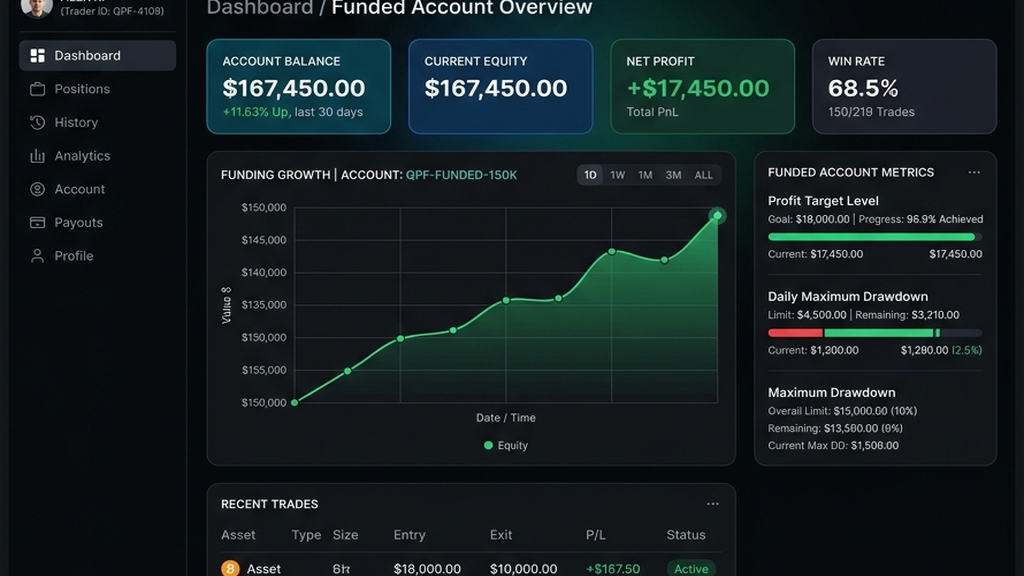
My active City Traders Imperium dashboard panel and account specifications.
The "Under the Hood" Reality
cTrader execution was clean, with a server ping of 170ms from New Zealand. MT5 was also available. Slippage was low during standard hours, but the trailing drawdown script monitors your account constantly, meaning any peak equity increase raises your loss floor automatically.
On CTI's dashboard, the cTrader account keys took nearly 18 hours to generate after payment went through. I had to follow up with support on Discord to get my credentials active.
Platform stability is essential when trading leveraged demo accounts, and physical server latency from New Zealand is an unavoidable reality. Signals from Auckland must travel long distances to reach servers in London or New York, leading to latency of 180ms to 240ms. If you are attempting to run high-frequency EA scripts or trade volatile events like the RBNZ interest rate decisions, this delay will result in frequent price slippage.
Speculating on simulated evaluation accounts requires a realistic understanding of probability. Statistically, less than five percent of traders who purchase a prop challenge ever pass both phases, and of those who do, less than one percent sustain their funding for more than three months. This high failure rate is not due to platform fraud, but rather to the psychological pressures of trading with high leverage. Retail traders often treat the evaluation as a lottery ticket, risking excessive size in a desperate attempt to pass quickly. To survive in this space long-term, you must view challenge fees as business operational costs rather than guaranteed investments.
From an operational perspective, the execution feed provided by prop firms is a simulated environment routed through third-party broker liquidity pools. Because you are not trading real securities on an exchange, the broker has significant control over the spreads and execution speeds. During volatile news releases, the feed can suffer from order delay and wide spreads. The best execution strategy is to focus on liquid trading hours, such as the London and New York overlaps, and avoid entering trades when liquidity is thin, as this is when execution latency will have the greatest impact on your entry prices.
Developing a mathematical approach to position sizing is the only way to protect your simulated capital. Utilizing basic risk-to-reward ratios of at least 1:2 is a starting point, but you must also factor in the maximum daily loss reset. If your daily drawdown limit is five percent, risking more than one percent per trade gives you very little room to recover from a bad run. A string of three consecutive losses will leave you on the brink of breach. By scaling your risk down to zero point five percent per trade, you give yourself the statistical breathing room required to ride out normal market distributions.
Fees, Spreads, and Commission Clarity
Registration fees are higher but refundable. Spreads on EUR/USD average 0.9 pips, and commissions are competitive. The direct funding option is expensive but removes the evaluation phase, which is a major benefit for experienced traders with proven systems.
The spread width is another technical variable that retail day traders often miscalculate. While the platform might advertise raw spreads starting from 0.0 pips, the reality on simulated demo feeds is that spreads widen during the daily market rollover (around 9:00 AM NZT). During this low-liquidity window, EUR/USD spreads can jump from 0.2 pips to over 2.5 pips. If you have active swing positions with stop-loss orders placed too close to the market price, this temporary spread widening will trigger your stop-loss or automated daily drawdown limit even if the actual market price has not moved against your setup.
| Account Size | Profit Split Potential | Refundable Fee |
|---|---|---|
| $2.5K to $100K | Up to 100% | Yes |
| Platforms Supported | MT5 / cTrader | Direct integration via MT5 / Proprietary |
| Payout Frequency | Monthly | Processed through Deel, Bank Wire, or Crypto |
Regulatory Landscape & Trust in New Zealand
CTI is offshore and not regulated by the FMA in New Zealand. You have no local investor protections. Profit splits are treated as standard service contract income by the IRD and are fully subject to local income tax rates.
Kiwi day traders must be blunt about where offshore prop firms are registered. Since they do not offer retail derivatives, they do not hold a Derivatives Issuer license from the Financial Markets Authority (FMA), meaning you trade without local investor protection or access to dispute resolution schemes like FSCL. Under IRD guidelines, payouts are classified as contractor service income and taxed at your personal marginal tax rate.
The "Why I Use It (or Why I Don't)" Section
I use CTI's instant funding option for a portion of my capital because it allows me to bypass the evaluation phase entirely. However, I maintain strict trailing stop-losses to prevent the automated trailing drawdown from disabling my account on market pullbacks.
My approach to prop trading is practical: treat challenge fees as fully exposed risk capital. Successful prop trading requires scaling your risk down to 0.5% or 1% per setup to survive a string of losses without triggering the automated daily drawdown blocks.
Pros & Cons
Here is a balanced and honest comparison of what works well and where the platform falls short for New Zealand residents.
What I Like:
- Direct instant funding options bypassing evaluations
- cTrader support with clean execution log tools
- Profit splits scale up to 100% over time
Platform Flaws & Annoyances:
- Trailing drawdown rules track peak equity and are highly restrictive, which can terminate accounts quickly.
- Slow monthly payout frequency on standard funded accounts compared to the industry standard.
- Trailing drawdown rules track peak equity and are highly restrictive
- Monthly payout cycles are slower than modern standards
- Higher upfront costs for direct funding accounts
Sajid
Senior Retail Trader & NZ Market Analyst
Trading since 2012
Last updated
June 2026
New Zealand-based retail Forex and binary options trader since 2012. Cynical, battle-tested, and focused on risk preservation.
Risk Warning
Trading Forex, binary options, and CFDs involves significant risk of loss. These instruments are not suitable for all investors. You should carefully consider whether trading is appropriate for you given your financial situation, investment objectives, and level of experience. You may lose some or all of your invested capital. Only trade with money you can afford to lose entirely.