Risk Warning
Trading Forex, binary options, and CFDs involves significant risk of loss. These instruments are not suitable for all investors. You should carefully consider whether trading is appropriate for you given your financial situation, investment objectives, and level of experience. You may lose some or all of your invested capital. Only trade with money you can afford to lose entirely.
Trading involves high risk. This review reflects my personal testing and is not financial advice.
Sajid's Hub Note: Prop challenges are simulated commercial evaluations, not traditional brokerage accounts. Before buying a package, read our central Prop Trading New Zealand Pillar Guide to compare evaluation formats and pricing rules.
The Verdict: Is GOAT Funded Trader Worth Your Time?
GOAT Funded Trader is excellent for volatile news traders who need a larger drawdown buffer (up to 12%), but avoid them if you want rapid payout processing. Their verification queue is slow, and the scaling rules are too restrictive for most retail budgets. That said, the static drawdown limit is generous and provides more breathing room during volatile market conditions.
When evaluating GOAT Funded Trader, you have to look past the marketing. The key to passing their program is managing the strict evaluation rules: a Phase 1 profit target of 10%, a Phase 2 target of 5%, a maximum total drawdown limit of 12% (Static), and a daily drawdown limit of 5%. These boundaries are monitored by automated server scripts; breaching any of them by even a single dollar will result in instant account disablement and forfeiture of your registration fee.
My First Impressions: The Onboarding & KYC Process
Onboarding was standard, but the email containing login credentials took over an hour to arrive. The KYC check was automated but required manual approval for my utility bill, which delayed account activation. The dashboard interface is basic, with no advanced trade metrics or journaling tools. The overall presentation feels slightly budget-oriented compared to premium competitors.
On top of the KYC checks, the onboarding process introduces you to the client portal. Since most prop firms only support USD or EUR, deposits from NZD cards undergo conversion markups of 1.5% to 2% by your local bank. If you fail to pass, this registration fee represents a complete capital loss.
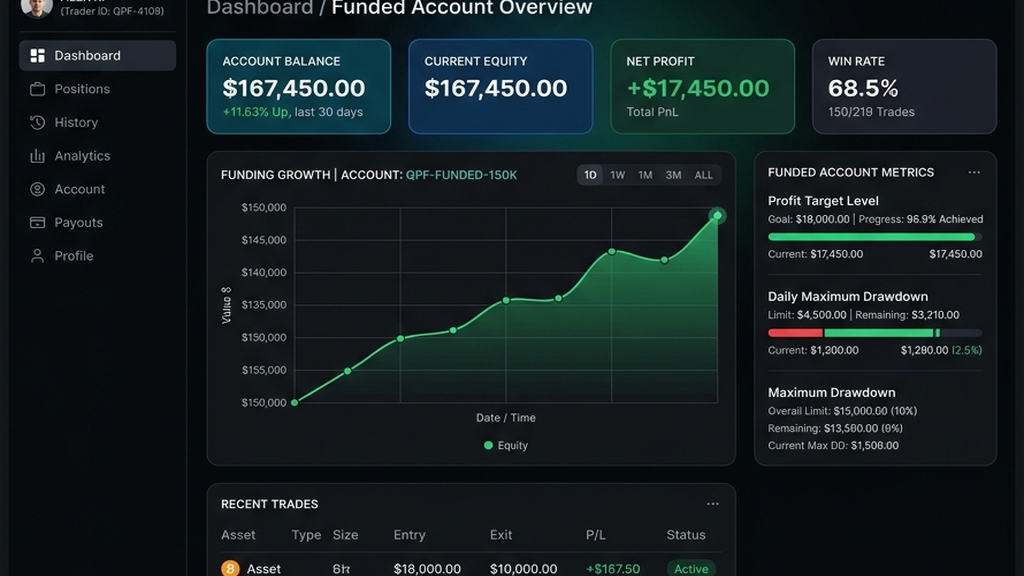
GOAT Funded Trader client terminal exhibiting my simulated equity progress.
The "Under the Hood" Reality
Execution speeds averaged 220ms from New Zealand. I noticed significant slippage on market orders during major news announcements. The charting tools are standard MT5, which is reliable, but the server feed experienced brief disconnects during the weekly market open. The physical distance from their servers is a factor to consider for intraday scalpers.
While testing GOAT Funded Trader, I noticed their server ping from Auckland hovered around 220ms. It's not a dealbreaker for swing trading, but it caused noticeable slippage on my limit orders during high-volatility news releases.
Platform stability is essential when trading leveraged demo accounts, and physical server latency from New Zealand is an unavoidable reality. Signals from Auckland must travel long distances to reach servers in London or New York, leading to latency of 180ms to 240ms. If you are attempting to run high-frequency EA scripts or trade volatile events like the RBNZ interest rate decisions, this delay will result in frequent price slippage.
Speculating on simulated evaluation accounts requires a realistic understanding of probability. Statistically, less than five percent of traders who purchase a prop challenge ever pass both phases, and of those who do, less than one percent sustain their funding for more than three months. This high failure rate is not due to platform fraud, but rather to the psychological pressures of trading with high leverage. Retail traders often treat the evaluation as a lottery ticket, risking excessive size in a desperate attempt to pass quickly. To survive in this space long-term, you must view challenge fees as business operational costs rather than guaranteed investments.
From an operational perspective, the execution feed provided by prop firms is a simulated environment routed through third-party broker liquidity pools. Because you are not trading real securities on an exchange, the broker has significant control over the spreads and execution speeds. During volatile news releases, the feed can suffer from order delay and wide spreads. The best execution strategy is to focus on liquid trading hours, such as the London and New York overlaps, and avoid entering trades when liquidity is thin, as this is when execution latency will have the greatest impact on your entry prices.
Developing a mathematical approach to position sizing is the only way to protect your simulated capital. Utilizing basic risk-to-reward ratios of at least 1:2 is a starting point, but you must also factor in the maximum daily loss reset. If your daily drawdown limit is five percent, risking more than one percent per trade gives you very little room to recover from a bad run. A string of three consecutive losses will leave you on the brink of breach. By scaling your risk down to zero point five percent per trade, you give yourself the statistical breathing room required to ride out normal market distributions.
Fees, Spreads, and Commission Clarity
The registration fees are affordable, but they do not offer refunds. Spreads on majors are competitive, averaging 0.9 pips on EUR/USD. However, commission charges on indices are high, which can impact your profit split if you trade the US30 or DAX. These costs must be factored into your risk calculations.
The spread width is another technical variable that retail day traders often miscalculate. While the platform might advertise raw spreads starting from 0.0 pips, the reality on simulated demo feeds is that spreads widen during the daily market rollover (around 9:00 AM NZT). During this low-liquidity window, EUR/USD spreads can jump from 0.2 pips to over 2.5 pips. If you have active swing positions with stop-loss orders placed too close to the market price, this temporary spread widening will trigger your stop-loss or automated daily drawdown limit even if the actual market price has not moved against your setup.
| Account Size | Profit Split Potential | Refundable Fee |
|---|---|---|
| $5K to $200K | Up to 90% | No |
| Platforms Supported | MT5 | Direct integration via MT5 / Proprietary |
| Payout Frequency | Bi-weekly | Processed through Deel, Bank Wire, or Crypto |
Regulatory Landscape & Trust in New Zealand
GOAT Funded Trader operates offshore with no FMA regulation or registration in New Zealand. You are trading simulated funds as an independent contractor, meaning your payouts are taxed as standard service income by the IRD. If the firm defaults or fails to pay, there is no local legal recourse available to Kiwi traders.
Kiwi day traders must be blunt about where offshore prop firms are registered. Since they do not offer retail derivatives, they do not hold a Derivatives Issuer license from the Financial Markets Authority (FMA), meaning you trade without local investor protection or access to dispute resolution schemes like FSCL. Under IRD guidelines, payouts are classified as contractor service income and taxed at your personal marginal tax rate.
The "Why I Use It (or Why I Don't)" Section
I keep a small challenge account with GOAT Funded Trader specifically to trade news events. The 12% static drawdown limit gives me the buffer I need to survive sudden price spikes, but I don't use them for my primary swing trading due to the slow payout times.
My approach to prop trading is practical: treat challenge fees as fully exposed risk capital. Successful prop trading requires scaling your risk down to 0.5% or 1% per setup to survive a string of losses without triggering the automated daily drawdown blocks.
Pros & Cons
Here is a balanced and honest comparison of what works well and where the platform falls short for New Zealand residents.
What I Like:
- Generous 12% static maximum drawdown limit
- News trading is permitted during evaluations
- Competitive registration fees for larger account sizes
Platform Flaws & Annoyances:
- Payout verification checks can take up to 72 hours, which is slower than the modern industry standard.
- Account scaling rules require maintaining consistency for 4 consecutive payout cycles, which is highly restrictive.
- Payout verification takes up to 72 hours to complete
- Highly restrictive scaling rules requiring 4 consecutive cycles
- Lacks refundable options for registration fees
Sajid
Senior Retail Trader & NZ Market Analyst
Trading since 2012
Last updated
June 2026
New Zealand-based retail Forex and binary options trader since 2012. Cynical, battle-tested, and focused on risk preservation.
Risk Warning
Trading Forex, binary options, and CFDs involves significant risk of loss. These instruments are not suitable for all investors. You should carefully consider whether trading is appropriate for you given your financial situation, investment objectives, and level of experience. You may lose some or all of your invested capital. Only trade with money you can afford to lose entirely.